
Small Businesses Don't Need More Advertising Tools. They Need Customers.
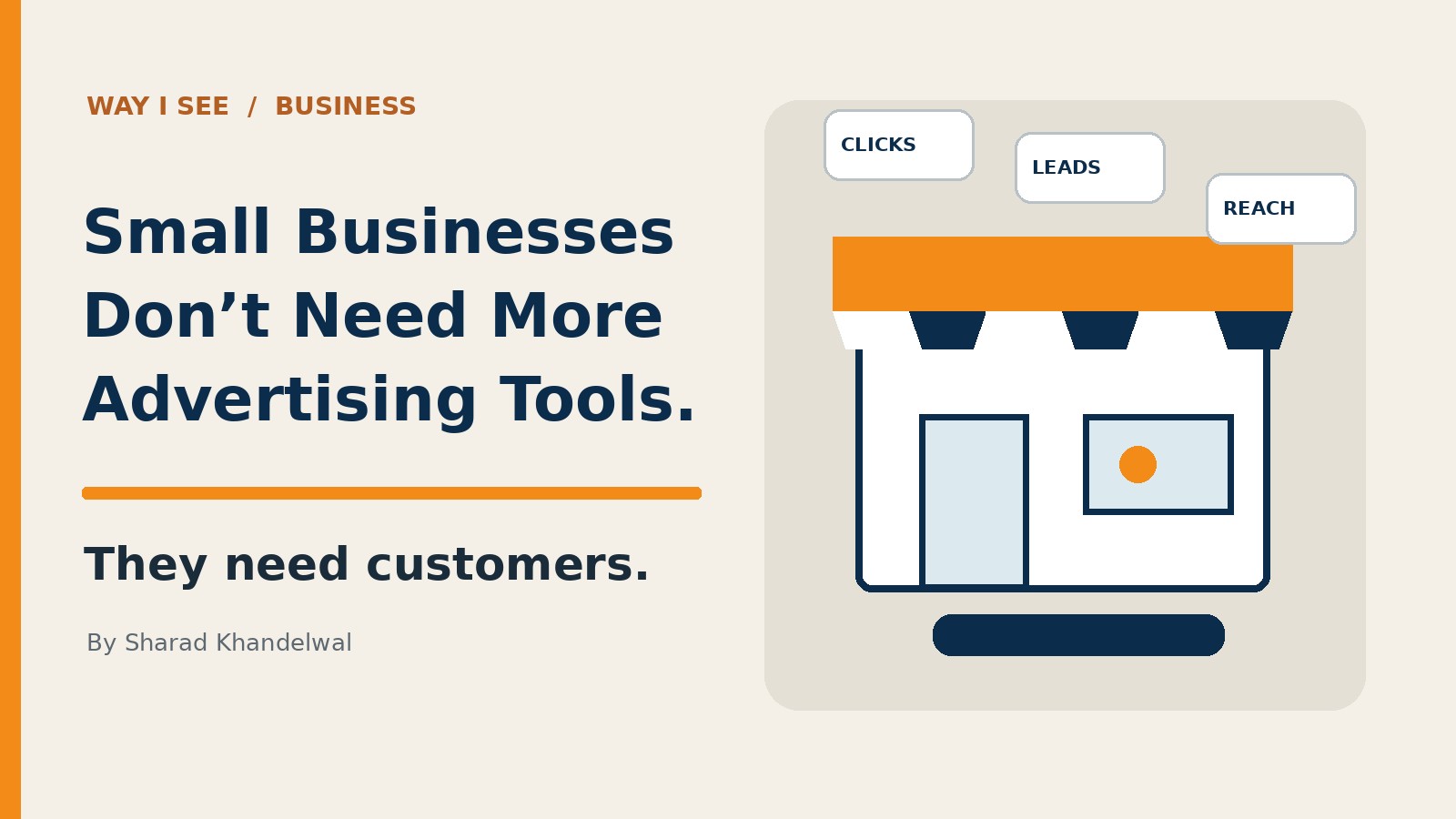
A small business owner opens a laptop in the morning. There are customers to follow up with, payments to collect, a few pending orders, and perhaps an employee waiting for instructions.
Somewhere in between all this, the business owner is also expected to become a digital marketing expert.
Create a campaign. Choose an objective. Define an audience. Install a tracking pixel. Connect an account to another account. Verify a domain. Learn what a conversion is. Then learn why the conversion is not being recorded.
And after all that, the business owner still has the same simple question: **Will this bring me customers?**
I run a small digital services business, so I have seen both sides of this table. I help businesses build websites and reach people online. I also understand the frustration when a tool that promises to make marketing easier begins demanding more time than the actual business.
The shopkeeper didn't ask for a dashboard
Imagine someone running a small gift shop, a coaching centre, a local publisher or a neighbourhood service business. They know their products. They know the questions customers ask. They may even know exactly which part of the city they want to serve.
What they often don't know is why an advertisement that worked last month suddenly needs a new setup, or why a lead has appeared in one dashboard but not in the place where they actually manage enquiries.
We are told these systems are becoming smarter. Perhaps they are. But the experience for the person paying the bill does not always feel smarter.
I sometimes wonder whether we have confused the sophistication of a tool with its usefulness.
A lead is not a customer
Digital advertising platforms are very good at showing numbers. Reach. Impressions. Clicks. Engagement. Leads. Cost per result.
These figures can be useful. I don't dismiss them. But a business cannot pay its electricity bill with impressions, and an enquiry that never answers the phone is not the same as an order.
A local business might receive twenty enquiries and convert only one. Another campaign might bring five enquiries and convert three. The dashboard may celebrate the first campaign because its cost per lead was lower. The owner, quite reasonably, may prefer the second.
What matters is not how busy the dashboard looks. It is whether the business is getting meaningful conversations, orders and repeat customers.
The hidden cost of 'easy' advertising
There is another cost that rarely appears in the campaign report: the time spent managing the campaign itself.
A small-business owner may spend an evening watching tutorials, fixing account permissions, preparing creatives and figuring out which button moved after the latest interface update.
For a large company, there may be a marketing department for this. For a small company, the marketing department is often the same person who handles sales, accounts and customer complaints.
Of course, advertising requires some effort. I am not suggesting that a good campaign should be as simple as switching on a fan. But shouldn't the technology be doing more of the complicated work instead of passing it to the user?
Discoverability should not be a luxury
Here is something I feel strongly about: a genuinely good local business should not remain invisible simply because its owner cannot afford to keep advertising.
If someone searches for a nearby service, a reliable shop or a particular product, the results should help that person discover relevant options. Clear business information, honest reviews, accurate availability and a useful website ought to count for something.
Paid promotion has its place. Businesses should be able to pay to reach more people. But basic discoverability should not feel like a subscription to being noticed.
And when an advertisement is shown, I would rather see one relevant, transparent promotion than a stream of interruptions that leaves both the customer and the advertiser dissatisfied.
What I would like to see instead
My ideal marketing tool for a small business would begin with ordinary questions.
What do you sell? Where do you serve customers? What makes your offering useful? How much can you comfortably spend? What should happen when someone is interested?
Then it would help create a sensible campaign, connect the enquiry to a simple follow-up system and report results in language the owner understands: **people contacted, serious enquiries, orders received, money spent**.
It would also be honest when something isn't working. Not every business needs every platform. Not every campaign needs to run all month. And not every problem can be solved by increasing the budget.
I realise this may sound less exciting than a dashboard full of graphs. But I suspect it would be far more valuable.
Perhaps we are asking the wrong question
When a new advertising feature is launched, the discussion is usually about what the platform can now do.
I would like us to ask a different question: **what can the business owner now do more easily?**
Can they spend less time learning software and more time serving customers? Can they understand where their money went? Can they make a decision without needing a dictionary of marketing terms?
Technology should give a small business a bigger opportunity, not a bigger administrative burden.
Because at the end of the day, the shopkeeper didn't open a business to manage ad accounts.
**They opened it to serve customers.**
 Social Media · 17 Oct 2026I Have 2,000 Facebook Friends. Where Have They Gone?
 Technology · 16 Oct 2026We Have Faster Internet. But Are Our Lives Getting Better?
 Technology · 15 Oct 2026When Did Technology Become So Complicated?