
Why Must I Buy a New Phone When My Old One Still Works?
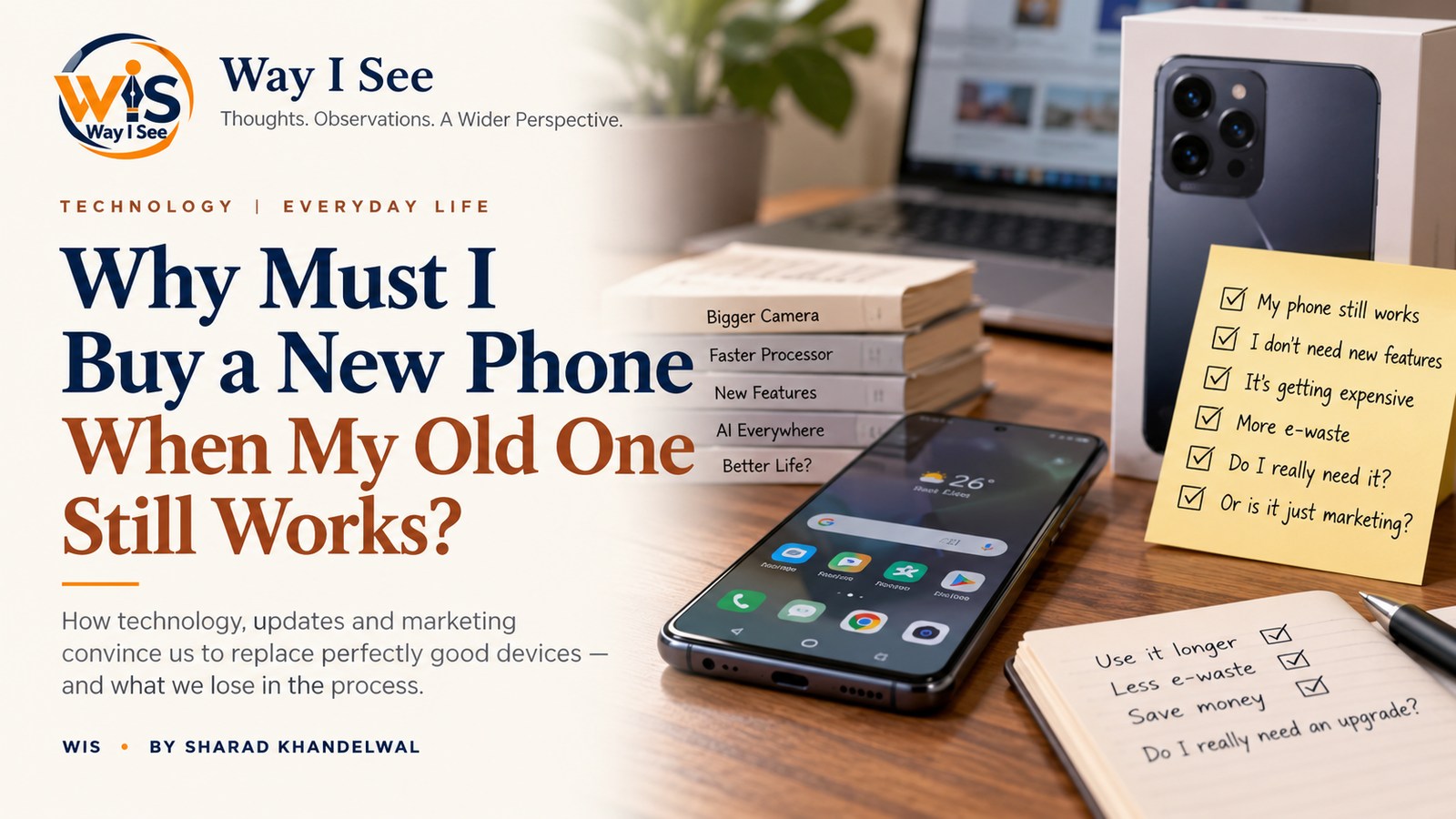
I have a question that may sound a little old-fashioned: if my phone is working perfectly well, why should I be thinking about buying another one?
It makes calls. It takes photographs. WhatsApp works. My banking apps work. I can read the news, check emails, pay bills and occasionally waste more time scrolling than I would like to admit.
By any reasonable definition, it is doing its job.
And yet, every few months, something seems determined to remind me that my phone is getting old.
Not because I have noticed a problem. Because someone else has decided that I should.
When did 'still working' stop being enough?
There was a time when we replaced a device because it stopped working, or because the new one could do something we genuinely needed. Today, the conversation often begins with a different question: how many years old is your phone?
Three years? Four? Five? That can be enough to invite a concerned look, as if you have been driving a vehicle without wheels.
Of course, technology improves. Cameras get better. Batteries become more efficient. Processors become faster. Some improvements are meaningful, especially for people who depend on their phones for demanding work.
But not everyone is editing videos or playing graphics-heavy games. Many of us are doing much the same things we did five years ago. The apps may look different, but the tasks haven't changed very much.
So why does the device suddenly feel inadequate?
Sometimes the phone doesn't get old. The software gets heavier.
I work with websites and applications, and I know software needs updates. Security vulnerabilities must be fixed. New standards need support. Nobody wants to keep using an unsafe system just to avoid change.
But I also see another side of it.
An application that once opened instantly begins taking longer. A simple feature becomes a collection of menus. An update adds something I never asked for, while moving the button I use every day. A familiar app now wants more memory, more storage and a newer operating system.
Eventually, a message appears: This version is no longer supported.
The phone hasn't fallen off the table. The screen hasn't broken. The processor hasn't stopped processing. Yet an important app may refuse to run.
Sometimes there are genuine security or technical reasons for that decision. But I wish companies were clearer about which reasons are essential and which are simply convenient for development.
For a customer, the distinction matters. One means a necessary upgrade. The other can mean buying new hardware to accommodate a software decision.
The expensive cycle of being 'up to date'
A new phone is not a small purchase for many families. And the cost isn't always limited to the phone.
There may be a new charger, a new case, a screen protector and the time spent transferring everything. Banking applications need to be activated again. Accounts demand passwords or OTPs. Something important inevitably refuses to move across as smoothly as the advertisement promised.
After all that effort, what do we often do first?
Open WhatsApp.
I find that a little amusing. We go through a fairly complicated process to return to almost exactly where we were yesterday.
This doesn't mean nobody should buy a new phone. If the battery has become unreliable, the device is no longer secure, or a better camera or faster performance would genuinely help, upgrading makes sense.
My question is about the pressure to upgrade before any of those reasons apply.
What about the phone we leave behind?
We often talk about technology as progress. But progress also has a physical side: materials, manufacturing, packaging, transport and electronic waste.
A working phone sitting unused in a drawer represents resources that have already been spent. Recycling is useful, and passing a device on to someone else can extend its life. But neither is quite the same as not needing a replacement in the first place.
I would like to see longer software support become a normal expectation, not a premium selling point. I would also like batteries and common parts to be easier and more affordable to replace.
And perhaps we could stop treating a four-year-old phone as a personal embarrassment.
What would technology designed for people look like?
Imagine a phone that receives security updates for many years, even after the manufacturer stops adding fashionable new features. Imagine apps offering a lighter mode for people who only need the basics. Imagine a battery replacement that costs a reasonable amount and doesn't feel like a risky operation.
Most importantly, imagine a company saying: Your phone is still good. Keep using it.
That would be a rather unusual advertisement, wouldn't it?
I understand that businesses need to sell products. Innovation matters. Competition pushes companies to improve. But I don't think the customer's interests and the manufacturer's interests must always be in conflict.
A company that helps me use a product longer may earn something valuable too: my trust.
The next time I buy a phone, I would rather choose a brand that respected the years I spent with the previous one than a brand that made me feel outdated for keeping it.
Perhaps that is the simplest test of useful technology.
Does it improve my life—or merely give me another reason to spend money?
 Technology · 16 Oct 2026We Have Faster Internet. But Are Our Lives Getting Better?
 Technology · 15 Oct 2026When Did Technology Become So Complicated?
 Society · 18 Oct 2026आपकी चुप्पी भी एक फैसला है